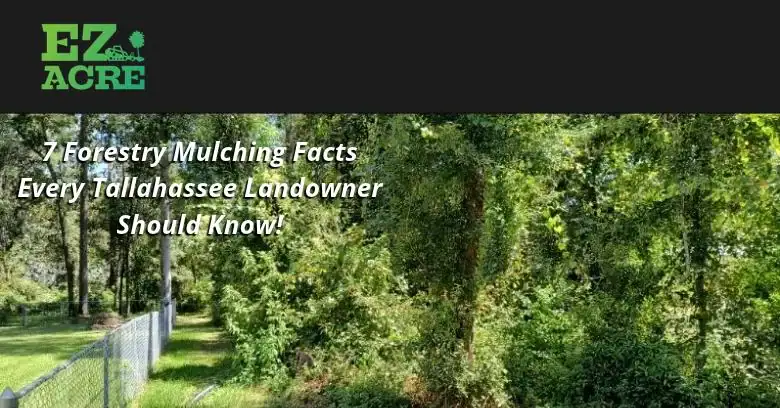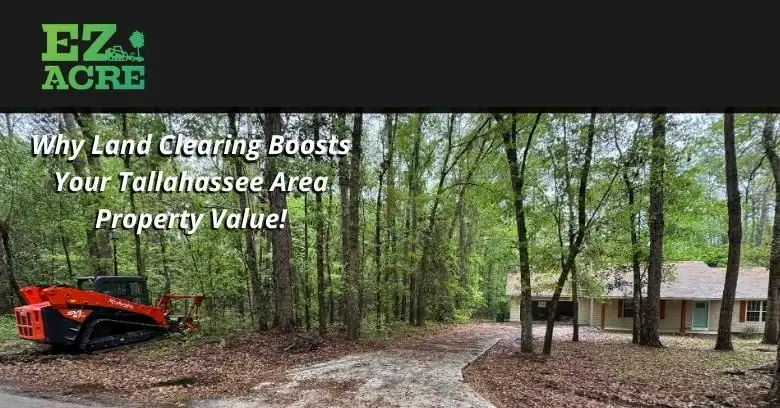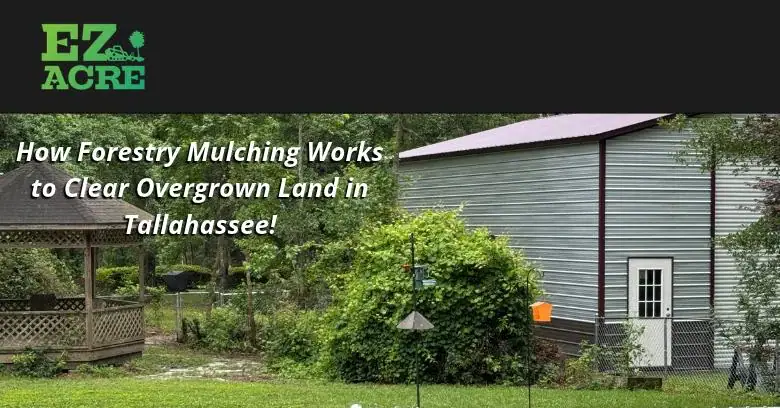
Overgrown land has a way of creeping up on a property owner. A back five acres that used to be walkable turns into a wall of privet and greenbriar in three or four wet summers. A fence line disappears. A pond bank gets swallowed. By the time most people in the Tallahassee, Florida, area start making calls, the brush is too thick to bush hog, too green to burn, and too expensive to haul off piece by piece. Forestry mulching solves that problem without a single dump truck leaving the property.
Professional forestry mulching contractors use a straightforward method: one tracked machine carries a rotating drum head that grinds standing brush, vines, and small trees in place, turning them into a layer of chips on the ground. There's no burn pile, no debris trailer, no open dirt left behind to wash out in a summer downpour. On land that gets roughly 59 to 65 inches of rain a year, most falls in the summer months, so keeping the soil covered matters more here than in drier parts of the country.
This article walks through how forestry mulching works mechanically, what equipment does the cutting, how North Florida's two very different soil types change the approach in Tallahassee and nearby areas like Monticello, what the work typically costs plus how fast it moves, and the permitting as well as utility-marking steps that come before the machine ever rolls off the trailer. It also covers the most common questions property owners ask such as whether stumps come back, whether the mulch kills grass, and will privet as well as tallow simply resprout.
What Forestry Mulching Is, and What It Isn't
One Machine, One Pass
A mulching head is a high-speed steel drum or disc studded with teeth. The operator drives it into standing vegetation, cuts the material, re-cuts it, and throws it down as forestry mulch. A six-inch sweetgum sapling that would take a crew with chainsaws, a skidder, and a dump trailer most of an hour disappears in under a minute. Because the material stays on site, the job skips the two slowest parts of traditional clearing: handling debris and disposing of it.
That disposal savings is real in Tallahassee, and throughout Leon County, where pile burning requires a Florida Forest Service burn authorization and a weather window that doesn't always cooperate. Skipping the pile entirely is one of the main reasons forestry mulching has taken over so much of the local clearing market.
Where Mulching Stops, and Grubbing Begins
Mulching cuts vegetation; it does not remove roots. Stumps are left flush to roughly two to six inches above grade with the root system intact underground. That's fine for pasture recovery, trails, hunting lanes, fencelines, and general property cleanup. It is not site prep for a house pad, a slab, or a septic drainfield. Those need grubbing and root raking with a dozer or an excavator, a different scope of work and a different price.
An honest forestry mulching contractor will say so up front. Property owners from Monticello, Florida, to the west side of Gadsden County sometimes expect bare dirt and get a chip blanket instead, which is a conversation worth having before the deposit, not after.
The Equipment Behind the Work
Carriers and Ground Pressure
Most forestry mulching runs on compact track loaders in the 75 to 120 horsepower range, machines like the Cat 299, ASV RT-120, or Takeuchi TL12. Excavator-mounted heads handle steep banks, ditch edges, and work where the operator needs reach instead of push.
Tracks matter as much as horsepower. Low-ground-pressure tracks run roughly 4 to 6 psi, compared with 25-plus psi for a wheeled machine. On saturated Red Hills clay, that difference decides whether a property gets cleared or rutted.
Heads and Teeth
Heads from Fecon, Denis Cimaf, FAE, and Diamond Mowers dominate the trade, and locals choose the teeth. Carbide teeth survive sand, grit, old fence wire, and buried junk. Planer or knife teeth cut faster and leave a finer chip, but they can break on North Florida's sandy soils. Experienced mulching contractors in this region lean towards carbide and accept the slower cut.
Cut capacity runs about 6 to 8 inches in diameter as routine work. Ten to twelve inches is slow and hard on teeth. Above that, a tree crew with saws is cheaper than grinding.
What the Ground Around Tallahassee Demands
Red Hills Clay to the North
North and northeast of Tallahassee, through Bradfordville, Florida, and out toward Centerville, Miccosukee, and Monticello, the soil is Red Hills clay. It holds water, smears under tracks, and ruts badly when worked wet. Scheduling forestry mulching around rain isn't optional on clay. A single afternoon storm can shut a site down for two days.
Karst Sands to the South
South toward Woodville and Crawfordville, Florida, the ground flips to Woodville Karst sand. It drains fast and supports machines after rain, unlike the ground north of town, which can strand equipment. The trade-off is what lies beneath: sinkholes, soft spots, and shallow limestone that can stop a head cold. Operators working the south end walk questionable ground before committing a machine to it.
The Overgrowth Most Local Properties Fight
The target list around the capital region is predictable, and each species behaves differently under a mulching head:
- Chinese privet and Chinese tallow or popcorn tree: cuts easily, resprout aggressively from the stump unless treated.
- Kudzu, wisteria, and Japanese climbing fern: vines foul the head and bind the drum; dormant-season work is far faster.
- Saw palmetto: dense, abrasive crowns that slow production and wear teeth hard.
- Titi, gallberry, and yaupon: thick but manageable, common in the flatwoods south of town.
- Sweetgum, water oak saplings, and loblolly volunteers: the classic abandoned-pasture mix, ideal mulching material.
- Cogongrass: never mulch this species; it spreads by rhizome, and a machine driving through a patch can seed it across the whole property.
Cogongrass deserves a flag and a herbicide plan, not a mulching pass. Any forestry mulching contractor who recognizes it on a walkthrough is saving the owner years of trouble.
Forestry mulching alone will not kill privet, tallow, or wisteria. Cut-stump herbicide, triclopyr or glyphosate applied within minutes of the cut, is what kills them. Without that step, a landowner near Monticello, Florida, can expect the same thicket back in two or three growing seasons.
Timing, Production Rates, and Cost
How Fast the Work Moves
A single machine can complete roughly half an acre to two acres per day. Light underbrush with clear sightlines can exceed two acres per day. Dense stems, vine-choked canopy, slopes, or heavy palmetto can drop a day's output below half an acre.
The best window for forestry mulching in North Florida is the winter dormant season when vines are down, sightlines are open, the ground is firm, and ticks, chiggers, rattlesnakes, and yellow flies are scarce. Yellow flies peak from late spring into midsummer. The worst window is high summer into early fall, with afternoon storms, saturated clay, and hurricane season on top of it.
What It Typically Costs
Trade-wide regional pricing for forestry mulching generally falls in these ranges:
- Light underbrush, open understory, few large stems: roughly $600 to $1,200 per acre.
- Heavy, mature, or vine-choked growth, palmetto, or storm-damaged tangle: roughly $1,500 to $3,500 per acre.
- Day rates, often used for small or irregular parcels: commonly $1,500 to $2,800.
Small jobs are usually priced by the day or half day because mobilization costs the same whether the parcel is half an acre or five.
Storm work has kept local crews busy for years. Hermine, Michael through Gadsden County, the 2024 tornadoes across Tallahassee, and the hurricanes that followed all left downed timber, blocked fencelines, and brush that filled in fast behind the damage.
Before the Machine Arrives
Call 811, Sunshine State One Call, at least two full business days ahead. That locate covers public utilities, not private infrastructure. 811 doesn't mark private water lines, septic laterals, irrigation, or invisible-fence wire, so the owner needs to flag them.
Mark well heads, septic lids, and drainfields with stakes or flagging before the walkthrough. A mulching contractor can work close to all three, but only if the operator knows where they are. The same applies to pond banks, power drops, and property corners.
Regulation matters too. Leon County and the City of Tallahassee both regulate protected and heritage trees and land disturbance above certain thresholds, and wetland work may require review through the Northwest Florida Water Management District. Canopy Road Protection Zones along roads such as Centerville, Miccosukee, Old Bainbridge, Meridian, and Old St. Augustine restrict clearing near the right-of-way. Verify specifics with Leon County Growth Management before scheduling.
After the Pass: Mulch Depth and Regrowth
Leave the mulch layer about two to four inches deep. At that depth, it suppresses weeds, holds soil through heavy rain, and breaks down over a season or two. Over about six inches, it smothers grass seeding, ties up nitrogen as it decomposes, and becomes wildfire fuel in a dry spring. Good operators spread as they go instead of piling chip in wide rows.
For pasture, most owners wait a season, let the chip settle, then seed. Regrowth before a maintenance pass typically runs 12 to 36 months depending on species and whether stumps were treated. Owners from Quincy, Florida, through the Monticello area often put the property on a two-year rotation, which costs far less than the first clearing did.
Conclusion
Forestry mulching clears overgrown property in one pass, with one machine, and leaves the soil covered instead of bare. It handles brush, vines, and stems up to about eight inches well. It doesn't remove roots, and it doesn't replace grubbing when the goal is a building pad. Knowing that difference is the single most useful thing a landowner can take into a bid conversation.
For property in the Tallahassee, Florida, area, timing and ground conditions drive results as much as equipment does. Clay to the north and karst sand to the south require different schedules. Mark your well, septic, and private lines, call 811 two business days ahead, and plan a cut-stump treatment if privet or tallow is in the mix. Start now: walk your property line this week and schedule a site assessment with an experienced forestry mulching contractor while the dormant-season window is still open!
Key Takeaways
- Forestry mulching grinds standing vegetation in place, so no haul-off, no burn pile, and no burn authorization are required.
- Stumps remain with roots intact, so mulching isn't enough site prep for a house pad, slab, or septic drainfield.
- The dormant winter months offer firm ground, bare sightlines, and far fewer ticks, snakes, and yellow flies than summer work.
- Mulch left two to four inches deep protects soil, while anything over six inches smothers new grass and ties up nitrogen.
- Privet, tallow, and wisteria resprout unless the stumps are treated with herbicide within minutes of cutting.
Frequently Asked Questions
Will the Mulch Kill My Grass, or Can I Plant Pasture Later?
You can plant pasture as long as the chip layer stays around 2 to 4 inches. At that depth, it breaks down within a season or two; thicker layers smother seed and tie up nitrogen.
Do You Haul the Debris Away?
No, the material stays on site as ground cover, and that is the point of the method. Skipping debris hauling and burn piles is what makes mulching faster and less expensive than conventional clearing.
Will Stumps Come Up Later When I Bush Hog?
Stumps are cut flush to about 2 to 6 inches above grade, so a bush hog deck set at normal height clears them. Roots stay in the ground and decay over several years.
Can You Work Around My Well Head, Septic Lids, and Drainfield?
Yes, as long as those features are flagged before work begins. 811 locates public utilities only, so the property owner must mark private water lines, septic laterals, and invisible-fence wire.
Is There a Minimum Job Size?
No, half-acre parcels are workable, but small jobs are usually priced by the day or half day instead of per acre. Mobilization costs the same whether the machine clears half an acre or five.
Will Privet and Tallow Just Grow Back?
Yes, both resprout vigorously if nothing but mulching is done. A cut-stump herbicide application of triclopyr or glyphosate within minutes of the cut kills them.
Do I Need a Permit In Leon County?
Possibly, depending on acreage, tree species, wetlands, and proximity to a Canopy Road Protection Zone. Check with Leon County Growth Management before scheduling, since protected and heritage trees carry separate rules.