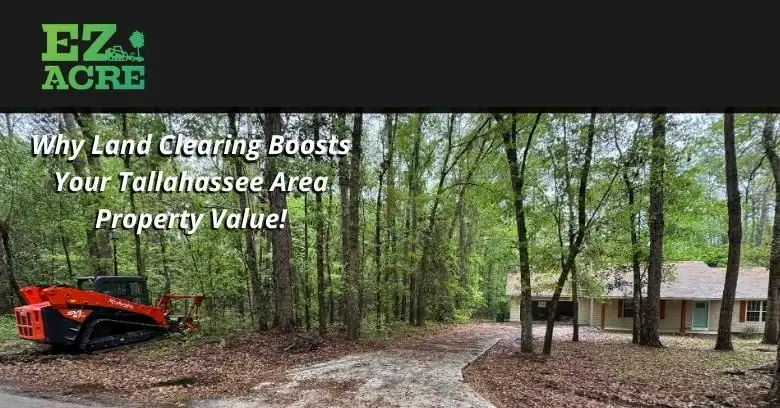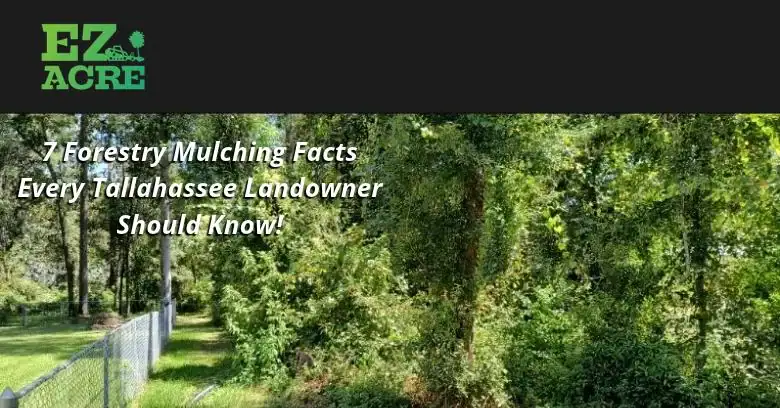
A twenty-acre tract off a Leon County dirt road can look like an asset on paper but, in person, it is a wall of Chinese privet, greenbrier, and sweetgum saplings. The property lines are out there somewhere. So are the old fence, the pond edge, and the building site that looked so obvious on the survey. Burning is slow and weather-dependent; a dozer leaves bare soil that washes away with the first heavy rain, and hauling debris off-site means trailers, tipping fees, and ruts down the driveway.
That is the gap forestry mulching fills. One machine with a rotary cutting head grinds standing brush and small trees where they stand, leaves the chips on the ground as a surface mat, and moves on with no burn pile, no haul-off, or no debris trailer parked at the road for a week. For landowners around Tallahassee, Florida, it has become the default first step for reclaiming overgrown acreage, opening trails, cleaning up fence lines, and getting a real look at what a property contains.
It is not magic, though, and the marketing photos rarely tell the whole story. Roots stay in the ground. Privet comes back. Wet-season work can tear up ground that took years to settle. Below are seven facts worth understanding before hiring anyone, covering equipment, costs, regrowth, timing, and the permitting questions that catch people off guard.
Fact 1: One Machine Does the Cutting, Grinding, and Cleanup
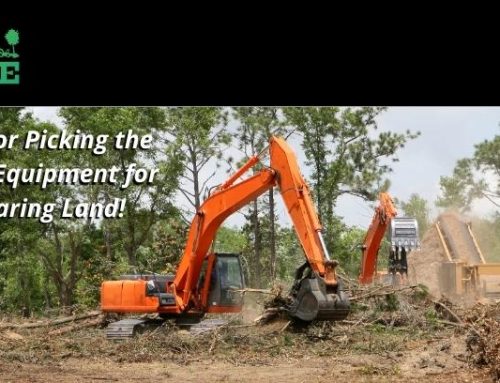
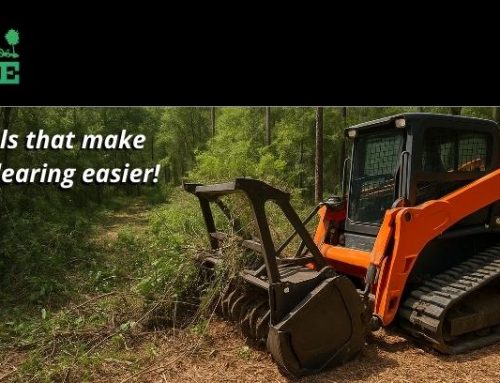
Conventional clearing is a sequence: cut, pile, haul or burn, then grade. Forestry mulching collapses that into a single pass. A drum or disc head mounted on a skid steer, compact track loader, or excavator feeds standing material into spinning teeth and discharges it as chips, which fall right where the brush stood.
The Machines Common in North Florida
Jobs across the Red Hills regularly feature the CAT 299D3 and XE, Bobcat T770 and T870, and ASV RT-120, paired with Fecon Bull Hog, FAE, Denis Cimaf, or Diamond heads. Horsepower drives capacity more than anything else as 75 to 120-plus hp separates a machine nibbling at saplings from one that chews steadily through an undergrowth. Most skid-steer heads top out at about 6 to 8-inch stems. Larger excavator-mounted heads reach 10 to 16 inches, which matters on parcels with mature water oak or laurel oak in the mix.
Carbide Teeth Versus Knife Teeth
Tooth choice is not a detail. Carbide teeth survive sand, grit, and the strands of old fence wire buried in half the pastures from Bradfordville, Florida, to the uplands near Quincy, Florida. Planer or knife teeth cut faster and leave a finer chip, but they dull quickly in sandy soil. An experienced forestry mulching contractor picks teeth based on what the site actually contains, not on what runs prettiest in a video.
Fact 2: It Does Not Remove Roots, Stumps, or Prepare a Building Pad
This is the single biggest misunderstanding. Forestry mulching cuts at or near grade and grinds what stood above it. Root systems stay in place, and stumps are either ground close to grade or left low. Soil structure remains undisturbed.
That is a feature, not a flaw. Undisturbed soil holds together through summer downpours and passes erosion scrutiny that grubbing and dozer work often do not. On rolling ground near Quincy, Florida, or in the Wakulla flatwoods around Crawfordville, Florida, leaving the root mat intact is frequently the difference between a stable site and a washed-out one.
With that in mind, mulching won't prepare a site for a slab, pad, or septic drainfield. Those still require grubbing, root removal, fill, and compaction testing. Treat forestry mulching as the step that reveals the site and makes it workable, then bring in the dirt contractor for anything structural.
Fact 3: The Mulch Mat Stays on the Ground and Does Real Work
Customers often ask when the chips get raked up. They do not. Material cut by forestry mulching is left as a surface mat, typically 2 to 6 inches deep depending on how much standing overgrowth there was. In Tallahassee humidity, with roughly 59 to 61 inches of rain a year, that layer breaks down in about 6 to 24 months.
While it breaks down, the forestry mulch earns its keep:
- It shades the soil and slows the first wave of weed seed from germinating.
- It cushions rainfall impact on slopes and reduces sheet erosion.
- It returns organic matter to sandy, nutrient-poor ground.
- It makes the site walkable right away, with no stubs or brush piles.
Thicker mats take longer to decompose and can delay seeding for pasture or food plots. If grass is the goal, say so up front, so the crew can mulch finer or spread the material thinner in the areas that matter.
Fact 4: Regrowth Is the Rule, Not the Exception
Nothing in the process kills roots. Cut a privet stem, and the plant responds by pushing new shoots from an intact root system that is now carrying the same energy with far less canopy to support. Chinese tallow, wax myrtle, yaupon, and greenbrier behave the same way, and many resprout within a single growing season.
What Comes Back Fastest
These invasives set the timeline: Chinese privet, Chinese tallow, coral ardisia, camphor, nandina, air potato, Japanese climbing fern, kudzu, and cogongrass. Cogongrass deserves its own mention because it spreads by rhizome on dirty equipment and is a Florida noxious weed. Any crew working infested ground should clean machines between sites, and landowners can ask whether they do.
Planning the Second Pass
Expect a follow-up pass in roughly 18 to 36 months, or a herbicide treatment applied to cut stems shortly after forestry mulching, when plants pull resources downward. The second visit costs far less than the first, because the material is smaller and the ground is already open. Owners who budget for maintenance from the start keep the property clear. Owners who treat the first pass as permanent usually end up back in a thicket within three years.
Fact 5: Late Fall Through Early Spring Is the Best Window
Timing affects both work quality and the ground's condition afterward. The dry stretch from late fall into early spring is the strongest window across the region:
- Ground is firm, so tracks float instead of rutting.
- Leaf-off conditions let the operator see property pins, old fences, wet areas, and the trees worth keeping.
- Tick pressure drops, yellow flies have not emerged yet, and snakes are far less active.
- Schedules are often more flexible than they are during storm-cleanup surges.
Leon County clay-over-sand soils rut badly after summer thunderstorms, and the wettest stretch of the year runs through the summer months. Wet-season forestry mulching is possible, but it carries real risk of track damage and pad repair, and a careful crew will say so rather than take the job blind. Hurricane season also drives a wave of blowdown and storm-debris work across Tallahassee, Florida, and the surrounding counties, which tightens availability when everyone needs help at once.
Fact 6: Price Tracks Density and Stem Size, Not Acreage Alone
Two ten-acre parcels can differ by a factor of four in cost. Cost depends on material per acre, stem thickness, ground slope, and how far the machine has to travel between work areas. Trade pricing nationally runs about:
- Light brush, vines, and briars: $700 to $1,800 per acre
- Mixed hardwood understory: $1,500 to $3,000 per acre
- Heavy stems over 8 inches: $3,000 to $6,000 and up per acre
- Day-rate work in the Southeast: roughly $1,500 to $3,000 per machine-day
Those are approximate and move with site conditions. Forestry mulching production typically runs 0.5 to 2 acres per day, and it drops below half an acre in dense titi, saw palmetto, or stands with 10-inch-plus stems. Plantation-country tracts near Monticello, Florida, and the rolling uplands outside Quincy, Florida, often price differently from flatwoods parcels even at identical acreage. A forestry mulching contractor who walks the property before quoting will give a number that holds. One who quotes from satellite imagery alone is guessing.
Fact 7: Permits, Protected Trees, and Buried Lines Still Apply
Forestry mulching is not automatically exempt from local rules, and no one should promise otherwise. Leon County Development Support and Environmental Management oversees land-disturbance review, and the City of Tallahassee Land Development Code includes tree and canopy provisions that govern protected and heritage trees. Canopy Road Protection Zones along Miccosukee, Old Bainbridge, Centerville, Meridian, Old St. Augustine, Sunny Hill, and Pisgah Church add another layer near those corridors.
A few more items belong on the checklist before a machine rolls off the trailer:
- Wetland and environmental resource permitting thresholds fall under the Northwest Florida Water Management District.
- Gopher tortoise burrows require buffers and FWC permitting before any disturbance nearby.
- Bald eagle nesting runs from fall into late spring and can restrict work within buffer distances.
- A Sunshine 811 locate request is free and requires two full business days' notice before digging or disturbing ground.
- The landowner should flag septic drainfields, well heads, irrigation lines, and property pins to be confirmed on site.
An experienced mulching contractor raises these questions during the walkthrough, not after a problem appears. Owners who want certainty should verify current code provisions with the county or city before scheduling.
Wrapping Up
Forestry mulching clears ground fast, leaves the soil intact, and costs less than cut-and-haul clearing on most overgrown parcels. It does not kill roots, it does not prepare a building pad, and it does not override local tree or wetland rules. Knowing that before the quote arrives is what separates a good outcome from a surprise.
Landowners in the Tallahassee, Florida, area get the most value by clearing during the dry season, budgeting for a follow-up pass, and flagging utilities, drainfields, and property pins ahead of time. EZ Acre works across Leon and the surrounding counties and treats every parcel like its own. Start now: walk the property, mark what matters, and schedule a site visit before the winter clearing window fills up!
Key Takeaways
- Mulching grinds brush and small trees in place, so you don't need a burn pile, haul-off, or debris trailer.
- Roots and stumps remain, so you still need to grub and compact slabs, pads, and drainfields.
- The chip mat stays on site and typically breaks down in North Florida humidity in 6 to 24 months.
- Privet, tallow, and greenbrier resprout, so plan a follow-up pass at 18 to 36 months or stump-stem herbicide treatment.
- Clear during the dry months for firm ground as well as better visibility, and confirm permits plus 811 locates before work starts.
Frequently Asked Questions
Will the brush grow back, and how soon?
Yes, most of it will, because the roots stay alive. Privet, tallow, wax myrtle, and greenbrier commonly resprout within one growing season, so plan on a maintenance pass or a herbicide treatment on cut stems.
Do I have to rake up or remove the mulch?
No, the chips are meant to stay where they fall. The mat suppresses weeds, slows erosion, and decomposes on its own, usually within six months to two years depending on thickness.
Does the mulch attract termites or fire ants?
Surface mulch is not a significant termite draw, since subterranean termites feed on wood in contact with soil moisture near structures. Keep the mat pulled back from foundations and wood siding to keep the risk low.
Can you mulch over my septic drainfield or irrigation lines?
Sometimes, but only after we locate and flag the area. Heavy machines can compact or crush shallow lines, so the crew needs those features marked before any pass is made.
Do I need a county permit?
Possibly, depending on acreage, location, wetlands, and protected trees. Check with Leon County Development Support and Environmental Management or the city code before assuming the work is exempt.
Can you work right after heavy rain?
Usually not without risk. Clay-over-sand soils rut badly when saturated, and a responsible crew will postpone rather than damage the ground you are trying to improve.
Can I plant pasture or build a fence afterward?
Fencing is generally fine once the ground is clear. Pasture seeding works better after the mulch mat thins, and structural building still requires stump removal and soil compaction.
How do you find my property pins?
The owner should locate and flag them, ideally with a survey. Dry-season, leaf-off conditions make pins far easier to find, which is another reason to clear in winter.